
Founder: Igor Severinovskiy & Eugene Volynsky
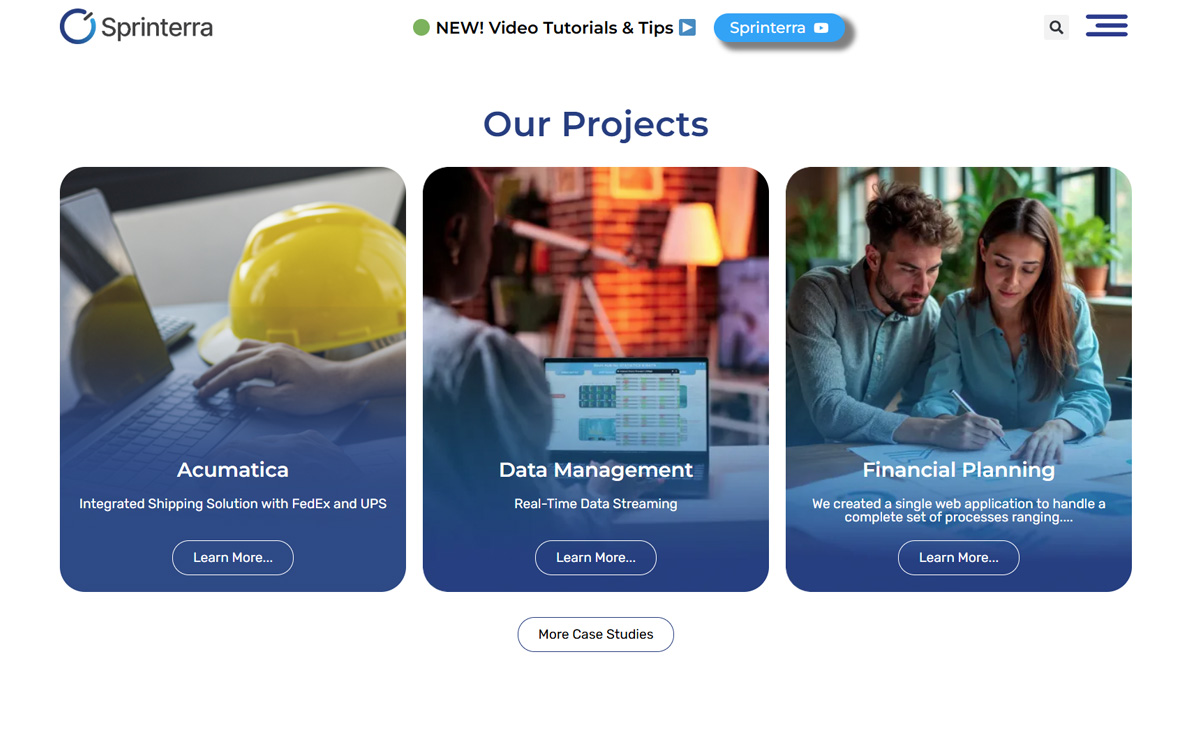
Website: Sprinterra
Use: Software development, Acumatica ERP, integrations and system modernization
Sprinterra Started Small, but the Software Around It Did Not Stay Simple
Sprinterra began with Igor Severinovskiy and Eugene Volynsky working from a home office and building software together. What followed was the familiar path of a technology company growing beyond its original setup: more people, more projects, more clients, more countries and, eventually, far more systems keeping the business running.
That growth created an interesting problem. Sprinterra had become very good at building technology for other companies, yet its own internal operations were becoming increasingly difficult to see in one place.
Project work lived in project-management tools. Financial information moved through spreadsheets. Employee hours had to be connected with payroll calculations. Different legal entities, contractors and international teams added another layer. Getting a clear view of a project often meant first collecting the pieces from several places.
Sprinterra had reached the same point many of its clients eventually reach: the individual tools still worked, but the business between those tools was becoming harder to manage.
They Became Their Own Client
Instead of treating the problem as another temporary spreadsheet headache, Sprinterra used its own company as the project.
The team chose Acumatica as the core ERP but quickly discovered that installing an ERP was only part of the answer. Their business had its own workflows, payroll logic, project reporting and existing software that could not simply disappear because a new system had arrived.
So they started building around it.
Jira work logs were connected to payroll calculations. Project budgets and actual results were brought together. Other internal systems were integrated instead of forcing teams to duplicate information manually. Sprinterra also developed its own Payroll and Project Management functionality around Acumatica where the standard setup did not match how the company actually operated.
That experience changed the relationship Sprinterra had with ERP work. They were no longer only developers implementing somebody else’s requirements. They had lived through the same questions their clients were asking: what stays, what gets replaced, what needs to connect, and where does custom development actually make sense?
The Real Problem Is Usually Between the Applications
Growing companies rarely wake up one morning and deliberately build a disconnected software stack. It happens gradually.
A CRM solves one problem. A project-management platform solves another. Accounting gets its own system. Someone builds a spreadsheet to bridge a gap between them, and that spreadsheet quietly becomes part of the company’s permanent workflow.
The wider problem is not unusual. The MuleSoft 2025 Connectivity Benchmark Report looks at the continuing difficulty businesses face connecting applications, systems and data as their technology stacks expand.
Sprinterra’s own experience adds an important detail to that discussion: replacing everything is not always the answer. Often, the more useful question is how the systems a company already depends on should exchange information.
That is also why Sprinterra’s step-by-step guide to Acumatica ERP integration spends so much time on integration rather than treating the ERP as an isolated piece of software. An ERP becomes far more useful when orders, customer information, project data, payments or other operational information can move between the systems that actually run the business.
From Home-Office Developers to Solving the Problem They Lived Through
Sprinterra today works far beyond its own internal ERP project, covering software development, Acumatica customization, integrations, data work, AI and modernization of older systems. But its internal Acumatica story remains one of the more interesting parts of the company because it removes the usual distance between developer and client.
Igor and Eugene did not have to imagine what disconnected business software feels like once a company grows. Their own team had already reached that point.
They had to decide which systems belonged together, where automation would actually remove work, and when the standard ERP needed to be changed around the business rather than the business being forced around the software.
That makes Sprinterra’s story less about selling another integration service and more about something much more practical: they built their way through the same software problem they now help other growing companies untangle.
Michael Feldman did not take the usual route into mental health care. Before working directly with psychiatric patients, much of his career was spent much closer to the biological side of medicine, studying molecular and cellular biology and taking part in research at institutions including the Weizmann Institute of Science and Mount Sinai.
That background matters because research teaches a particular way of looking at problems. When the first explanation does not fully match what you are seeing, you keep looking. You compare patterns, question assumptions, and avoid forcing every case into the same answer.
Michael eventually moved from laboratory research into clinical medicine and psychiatric care. After working with patients across inpatient and outpatient settings, he founded Gimel Health, a psychiatric practice built around giving that investigative part of care more room.
Disclaimer: This success story was written in collaboration with the Sprinterra team to share Igor Severinovskiy and Eugene Volynsky’s journey and the experience behind Sprinterra’s approach to software integration, as part of WebSEO Club’s free Success Story initiative.