
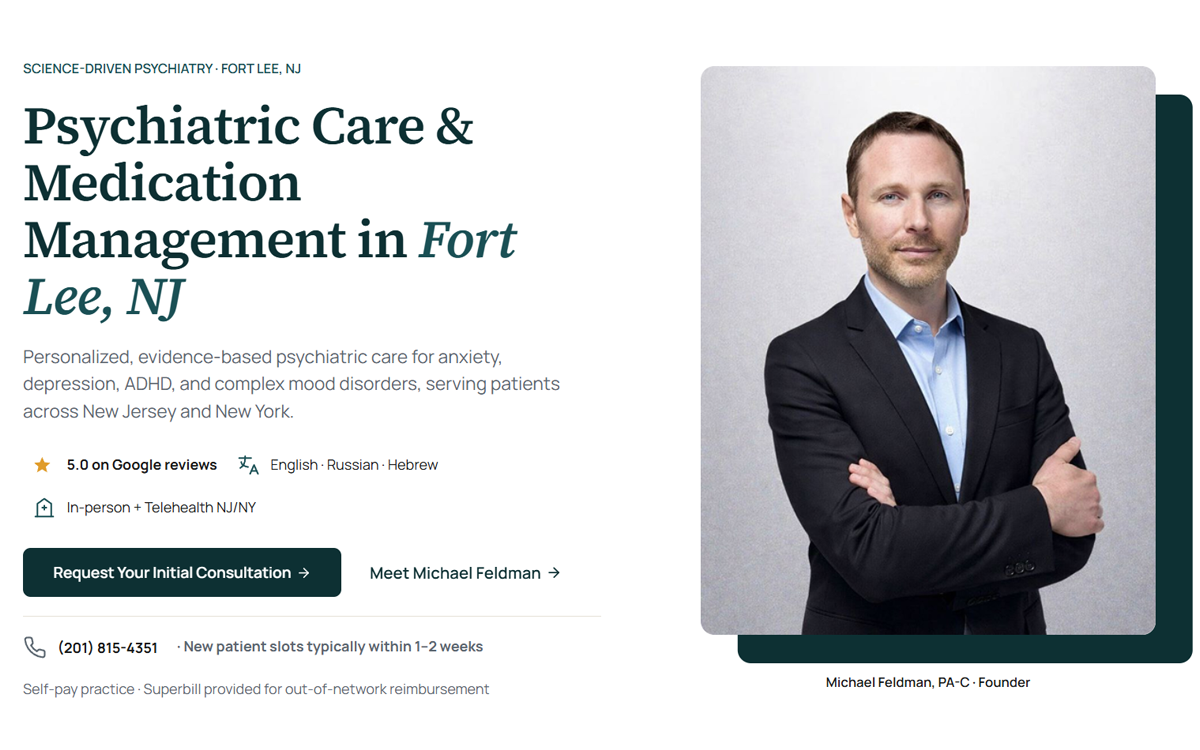
Founder: Michael Feldman, PA-C
Website: Gimel Health
Based In: Fort Lee, New Jersey
Use: Psychiatric evaluation and medication management for patients across New Jersey and New York
Meet Michael Feldman, the Founder Behind Gimel Health
Michael Feldman did not take the usual route into mental health care. Before working directly with psychiatric patients, much of his career was spent much closer to the biological side of medicine, studying molecular and cellular biology and taking part in research at institutions including the Weizmann Institute of Science and Mount Sinai.
That background matters because research teaches a particular way of looking at problems. When the first explanation does not fully match what you are seeing, you keep looking. You compare patterns, question assumptions, and avoid forcing every case into the same answer.
Michael eventually moved from laboratory research into clinical medicine and psychiatric care. After working with patients across inpatient and outpatient settings, he founded Gimel Health, a psychiatric practice built around giving that investigative part of care more room.
Gimel Health Was Built Around the Part of Care That Often Gets Rushed
Mental health appointments can become surprisingly mechanical. A patient describes a handful of symptoms, a familiar diagnosis appears to fit, medication is prescribed, and the next appointment becomes a quick check on whether it worked.
Gimel Health takes a different approach.
Michael places more weight on the initial evaluation: understanding the symptoms, previous diagnoses, medical history, medications already tried, what helped, what did not, and whether something in the patient’s story has been overlooked.
That makes Gimel Health particularly relevant for people who are not necessarily starting their mental health journey from zero. Some arrive after previous treatment. Others have been given a diagnosis but still feel that something about the explanation does not quite match what they experience.
The practice has also developed close relationships with therapists who refer clients when medication evaluation or psychiatric input becomes necessary. Instead of treating therapy and medication management as completely separate worlds, the aim is to keep both sides of care connected when the patient benefits from it.
PMDD Is a Good Example of Why the Details Matter
One of the areas Gimel Health works with is premenstrual dysphoric disorder, or PMDD.
At first glance, someone describing irritability, anxiety, low mood, or emotional changes before their period can sound like they are describing ordinary PMS. That is exactly why some people can spend years hearing that their symptoms are simply an unusually difficult part of their cycle.
The distinction becomes clearer when someone looks closely at the timing, severity, recurrence, and effect those symptoms have on daily life.
Gimel Health’s PMDD treatment approach fits naturally into the wider philosophy of the practice. The goal is not to hear one symptom and immediately attach a label to it. It is to understand the pattern, consider the patient’s wider psychiatric history, and work out whether PMDD, another mood condition, or an overlap between several factors better explains what is happening.
PMDD is only one part of the practice, but it is probably one of the clearest examples of why Michael’s approach matters. Two patients can use almost identical words to describe how they feel while experiencing two very different problems underneath.
Gimel Health is the result of bringing that mindset into mental health care.
A Small Practice With a Broad Mental Health Focus
Gimel Health today works with patients dealing with anxiety, depression, ADHD, bipolar disorder, OCD, eating disorders, PMDD, and more complicated cases where previous treatments have not produced the expected result.
Michael sees patients through the Fort Lee practice as well as through telehealth where available, and his ability to work in English, Russian, and Hebrew also allows him to serve patients who may feel more comfortable discussing personal mental health concerns in their first language.
What stands out about Gimel Health is not the length of its services list. Plenty of psychiatric practices can publish a similar one.
The more interesting part is how Michael arrived here.
He spent years studying biological systems, moved into clinical medicine, worked directly with psychiatric patients, and eventually built a practice around something his earlier career had already taught him: complicated problems rarely become clearer when you rush through them.
Disclaimer: This success story was written in collaboration with the Gimel Health team to share Michael Feldman’s professional journey and the approach behind the practice, as part of WebSEO Club’s free Success Story initiative.