
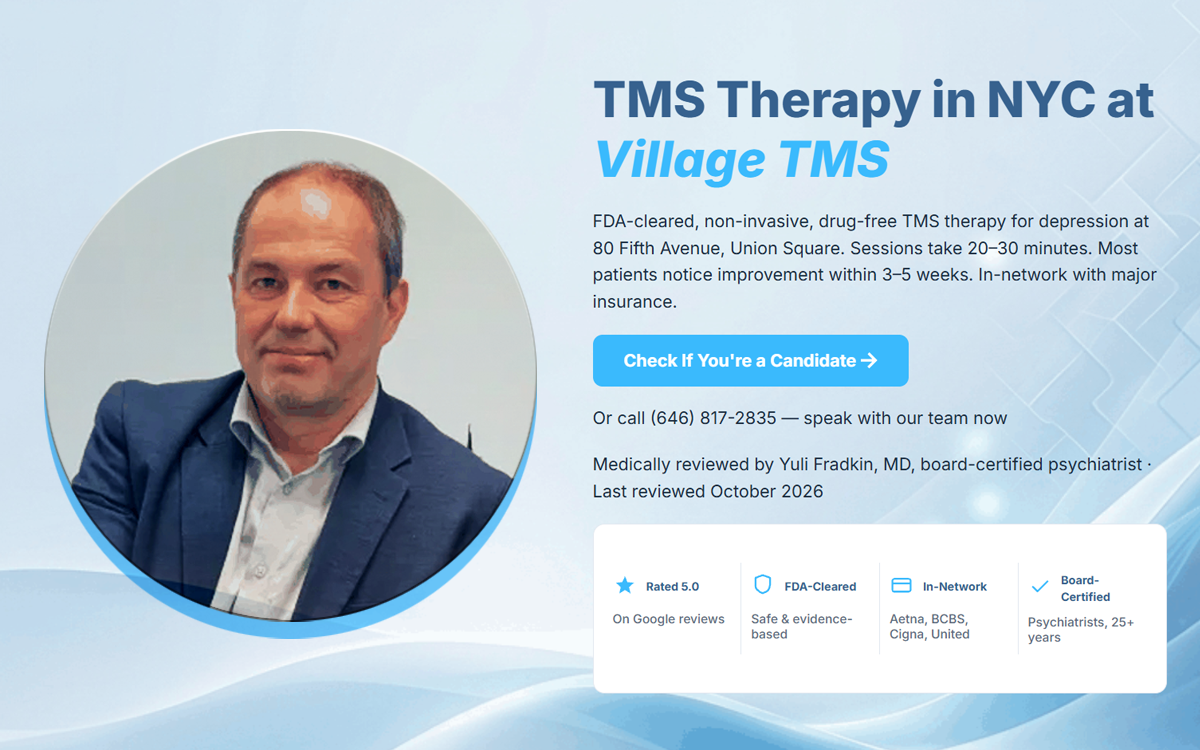
Founder: Dr. Yuli Fradkin, MD
Website: Village TMS
Based in: Manhattan, New York
Focus: TMS, Spravato, supervised ketamine therapy and psychiatric care
Dr. Fradkin’s Story Started Long Before Village TMS
Dr. Yuli Fradkin has spent much of his career looking at mental health from more than one direction. He began in child and adolescent psychiatry, worked in both inpatient and outpatient settings, took part in psychiatric research, and later taught and supervised medical students while continuing to work directly with patients.
That combination matters when looking at the practice he eventually built.
Across decades in psychiatry, Fradkin repeatedly encountered patients for whom the usual path had not been enough. Medications had been tried. Therapy had been tried. Diagnoses had already been made. Yet some patients were still arriving without the improvement they had expected.
That experience became one of the ideas behind Village TMS: instead of building another practice around one familiar treatment, create a place where the next option can depend on the patient rather than on whichever service the clinic happens to sell.
The Practice Was Built Around the Patients Who Still Needed Another Option
Village TMS now brings several forms of psychiatric treatment into the same Manhattan practice, including TMS, Spravato, IV and IM ketamine, medication management and ketamine-assisted psychotherapy.
The interesting part is not simply that all of those services exist under one roof. It is what that allows the clinical team to do.
A patient coming in with treatment-resistant depression does not automatically have to fit into one treatment model. Their previous medications, psychiatric history, current symptoms, medical risks and response to earlier treatments can all influence what happens next.
That reflects something Fradkin appears to have carried from his earlier work in psychiatry and research: when the first answer does not work, the next step should not simply be more of the same.
Village TMS has gradually grown around that principle, with board-certified psychiatrists making treatment decisions and other members of the team supporting areas such as psychotherapy and treatment integration.
Ketamine Shows Where That Philosophy Becomes Important
Ketamine is probably one of the clearest examples of why the way a treatment is delivered matters just as much as having access to the treatment itself.
The growth of online and at-home ketamine services created a very different model from the one Village TMS chose to build. In some cases, compounded ketamine may be supplied following remote evaluation and then taken away from a clinical setting.
The FDA has specifically warned about the risks associated with compounded ketamine products used for psychiatric disorders, including concerns when patients take them without on-site health-care monitoring. Its warning discusses risks including sedation, dissociation, changes in blood pressure and heart rate, respiratory depression, misuse and other adverse effects.
Village TMS went in the opposite direction.
Its ketamine therapy program is delivered inside the Manhattan clinic, with patient screening beforehand and monitoring during treatment. The practice offers IV and IM ketamine as off-label psychiatric treatments alongside Spravato, the esketamine treatment that has FDA approval for certain depressive disorders.
That distinction fits the larger story of the practice. The goal was never simply to make another treatment available. It was to keep the medical decision, administration and monitoring connected rather than separating the medication from the clinician responsible for the patient.
For anyone comparing ketamine options, the FDA’s warning on compounded ketamine products also makes that difference worth understanding before choosing where treatment happens.
From Child Psychiatry to a Different Kind of Mental Health Practice
Fradkin’s career has moved through child psychiatry, neuroscience research, teaching, inpatient care and private practice. Village TMS feels less like a departure from that history and more like the point where those different parts came together.
The clinic still treats mental health as a medical problem requiring evaluation, but it also gives the team more than one tool when a familiar approach has already failed. TMS can sit beside medication management. Spravato can be considered separately from IV or IM ketamine. Psychotherapy can be incorporated into ketamine-assisted treatment rather than being treated as an unrelated service.
That may be the most interesting part of the Village TMS story.
Dr. Fradkin did not build the practice around the idea that one new treatment would replace everything that came before it. He built it around patients for whom the first answers had already not been enough.
After more than two decades in psychiatry, Village TMS became his way of asking a more useful question:
What should we try when the standard path has already been tried?
Disclaimer: This success story was written in collaboration with the Village TMS team to share Dr. Yuli Fradkin’s professional journey and the story behind the practice, as part of WebSEO Club’s free Success Story initiative.